
FSSAI Water Testing Services in India: The Ultimate Guide to Compliance for Food Businesses
In the Indian food industry, water is more than just a resource; it is a critical ingredient and a primary utility. Whether you are running a high-end restaurant in Mumbai, a dairy processing unit in Punjab, or a cloud kitchen in Bangalore, the quality of water you use directly impacts the safety of your food and the validity of your FSSAI license.
The Food Safety and Standards Authority of India (FSSAI) mandates that every Food Business Operator (FBO) must ensure the water used in food handling, processing, and cleaning meets the IS 10500:2012 standards. Failing to provide a valid water testing report for FSSAI can lead to heavy penalties, license suspension, or even business closure during audits.
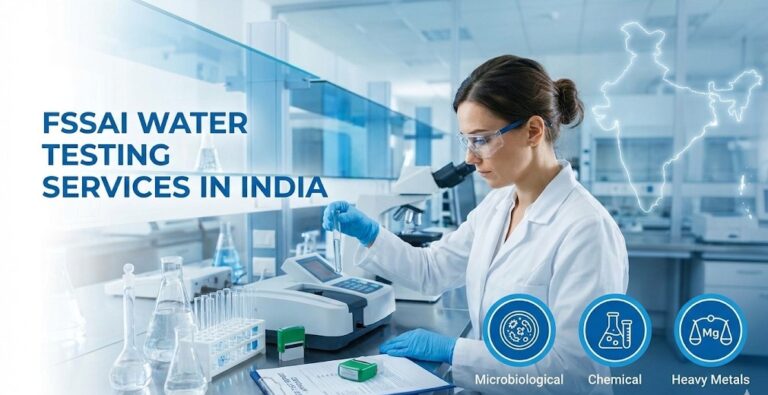
What Is Water Testing for FSSAI License Compliance?
Water testing under FSSAI refers to the scientific analysis of water samples to ensure they are free from harmful contaminants. Under the Food Safety and Standards (Licensing and Registration of Food Businesses) Regulations, 2011, water is classified as a “food” when it is used as an ingredient or comes into contact with food.
Regulatory Background
IS 10500 is the benchmark for drinking water quality in India. FBOs are required to test their water at NABL accredited water testing labs to ensure the data is legally valid and scientifically accurate.
Why Water Testing Is Mandatory for FSSAI License Approval & Renewal?
If you are applying for a new FSSAI license or seeking a renewal, a water test report is a non-negotiable document. Here is why it matters:
- Mandatory Compliance: Under Schedule 4 of the FSSAI regulations, every food unit must have a “potable water” certificate.
- Audit Readiness: During surprise inspections, Food Safety Officers (FSOs) primarily check for two things: pest control records and water testing reports.
- Legal Protection: In cases of foodborne illness outbreaks, having a valid, clean water report serves as your primary legal defense.
- Avoid Common Failures: A significant percentage of FSSAI audit failures in India occur due to “expired” water reports or testing done by non-accredited labs.
Types of Water Tested in Food Businesses
Depending on your location and infrastructure, the source of your water may vary. FSSAI requires testing for all of them:
- Municipal Water: Even if the government supplies your water, you are responsible for its safety once it enters your storage tanks.
- Borewell Water: Common in manufacturing units, borewell water is high-risk due to potential heavy metal and microbial seepage. Borewell water testing for food businesses often requires more frequent monitoring.
- RO / UV Treated Water: If you have an in-house treatment plant, FSSAI requires you to test the “output” water to ensure your filters are actually working.
- Process Water: Water used for steam generation, cooling, or cleaning equipment must also be tested if it risks cross-contaminating the food.
Key Water Test Parameters (Explained Simply)
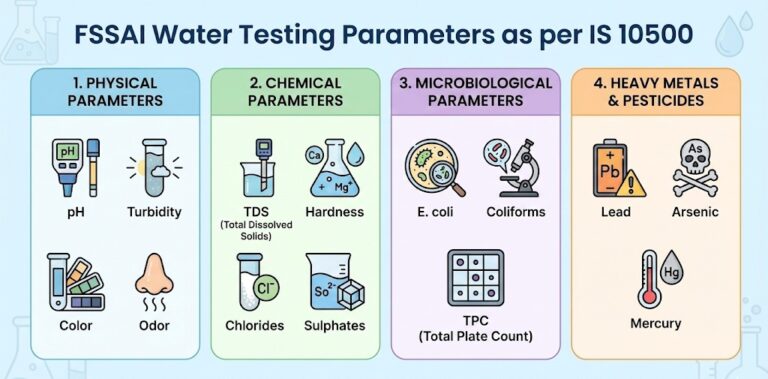
FSSAI requires a comprehensive analysis covering four main categories:
Physical Parameters
This checks the “look and feel” of the water.
- Turbidity: How cloudy the water is.
- Color & Odor: Ensures the water is clear and smell-free.
- pH Level: Maintains the acidity or alkalinity within the safe range of 6.5 to 8.5.
Chemical Parameters
These focus on dissolved substances that can cause long-term health issues.
- Total Dissolved Solids (TDS): Measures the concentration of dissolved minerals.
- Hardness: High calcium and magnesium can damage kitchen equipment and affect food taste.
- Chlorides & Sulphates: High levels can indicate industrial or sewage contamination.
Microbiological Parameters
The most critical for immediate food safety.
- E. coli & Coliforms: Presence of these indicates fecal contamination and can cause immediate food poisoning.
- Total Plate Count (TPC): Measures the overall microbial load.
Heavy Metals & Pesticides
High-risk parameters, especially for units using groundwater.
- Lead, Arsenic, and Mercury: Toxic metals that can accumulate in the body.
- Pesticide Residues: Essential for units in agricultural belts to ensure runoff hasn’t contaminated the source.
How Often Is Water Testing Mandatory for FSSAI?
As per the latest FSSAI guidelines (2025), the frequency of testing depends on the type of business, but the general rule is:
- Mandatory Frequency: At least once every six months (semi-annually).
- High-Risk Units: Dairies, meat processing units, and packaged drinking water plants may require monthly testing.
- Best Practice: We recommend testing after every major tank cleaning or if there is a change in the water source (e.g., switching from municipal to tanker water).
Always upload your latest reports to the FoSCoS portal to ensure seamless license renewals.
NABL Accredited Water Testing Labs – Why They Matter
A report from a local, uncertified lab is worth nothing in the eyes of the FSSAI. NABL (National Accreditation Board for Testing and Calibration Laboratories) accreditation ensures that the lab follows ISO/IEC 17025 standards.
- Legal Acceptance: Only NABL-accredited reports are accepted during FSSAI inspections.
- Accuracy: Accredited labs use calibrated equipment and standardized methods, minimizing the risk of “false negatives.”
- QR-Coded Reports: Modern NABL reports come with a QR code for instant verification by FSSAI officials.
Water Testing Process by MyFoodExpert
At MyFoodExpert, we simplify the complex world of compliance. Our process is designed for busy Food Business Operators:
- Professional Sampling: We send trained technicians to collect samples in sterilized containers to prevent external contamination.
- State-of-the-Art Testing: Samples are processed at our partner NABL-accredited labs using the latest chemical and microbiological techniques.
- Digital Delivery: Receive your FSSAI-compliant report digitally within 3 -7 working days. ( Depending on the parameters )
- Expert Consultation: If your water fails any parameter, our food safety experts provide a corrective action plan (e.g., recommending specific RO filters or chlorination levels).
Water Testing Cost in India
The water testing cost in India varies based on the depth of the analysis required.
- Basic Potability Test: Cheaper, covering basic physical and microbial parameters.
- Full FSSAI/IS 10500 Test: More expensive as it includes heavy metals and pesticides.
- Value vs. Cheap Testing: While low-cost labs may tempt you, an inaccurate report can lead to a “Non-Compliance” notice, which costs significantly more in fines and brand damage.
Common Mistakes Food Businesses Make
- Using Non-NABL Labs: Results are rejected by FSSAI, leading to wasted money.
- Expired Reports: Relying on a year-old report during a renewal application.
- Wrong Sampling Method: Collecting water in an unsterilized mineral water bottle, which leads to a “failed” microbial test.
- Ignoring Heavy Metals: Only testing for bacteria while ignoring toxic metals like Lead or Arsenic.
Why Choose MyFoodExpert for Water Testing?
We are India’s leading food safety consultancy, offering a one-stop solution for all your compliance needs.
- PAN-India Service: From Delhi to Chennai, we cover all major industrial and urban hubs.
- End-to-End Support: We don’t just give you a report; we help you with FSSAI License registration and Third-Party Audits.
- Quick Turnaround: We understand the urgency of license deadlines.
- Compliance-Focused: Our reports are specifically formatted to meet FSSAI auditor requirements.
Ensure Your Business Stays FSSAI-Compliant
Do not wait for a surprise FSSAI inspection to identify water quality issues. A non-compliant water report can lead to license suspension, penalties, or closure notices.
Book your FSSAI water testing today with a NABL-accredited lab.
Get fast, reliable, and audit-ready reports anywhere in India.
Visit our FSSAI Water Testing Services page to schedule sample collection or consult with our food safety experts.
FAQs – FSSAI Water Testing Services in India
Is water testing mandatory for FSSAI license?
Yes. Water testing is mandatory for FSSAI license approval and renewal. Every Food Business Operator (FBO) must maintain a valid water testing report for FSSAI from a NABL-accredited water testing lab, confirming compliance with IS 10500 drinking water standards.
What is a water potability certificate for FSSAI?
A water potability certificate for FSSAI is an official lab report that certifies the water used in food handling, processing, cleaning, or as an ingredient is safe for human consumption and meets IS 10500 standards. This certificate is mandatory under Schedule 4 of FSSAI regulations.
Which water sources need testing for FSSAI compliance?
FSSAI requires testing of all water sources used in food operations, including:
- Municipal (corporation) water
- Borewell / groundwater
- RO or UV-treated water
- Process water used for steam, washing, or cooling
Each source must have a separate water testing report for FSSAI.
How often is water testing required for FSSAI?
As per FSSAI guidelines:
- At least once every 6 months for most food businesses
- Monthly testing for high-risk units like dairies, meat processors, and packaged drinking water plants
Fresh reports are mandatory during FSSAI inspections and license renewal.
What is the validity of a water test report for FSSAI?
An FSSAI water test report is valid for six months from the date of issue. Reports older than six months are considered expired and non-compliant during audits or renewals.
Is NABL accreditation compulsory for FSSAI water testing?
Yes. FSSAI accepts only NABL-accredited water testing lab reports. Reports from non-NABL labs are rejected during inspections, even if test results are within limits.
What parameters are tested in FSSAI water testing?
FSSAI water testing includes:
- Physical parameters (pH, turbidity, color, odor)
- Chemical parameters (TDS, hardness, chlorides, sulphates)
- Microbiological parameters (E. coli, coliforms, TPC)
- Heavy metals & pesticides (lead, arsenic, mercury, residues)
This ensures full IS 10500 compliance.
Is borewell water testing mandatory for food businesses?
Yes. Borewell water testing for food businesses is compulsory because groundwater carries a higher risk of heavy metals and microbial contamination. FSSAI officers pay special attention to borewell water during audits.
What happens if water fails FSSAI test parameters?
If water fails:
- Stop using it immediately for food operations
- Identify contamination sources
- Install treatment systems (RO, UV, chlorination)
- Re-test water from a NABL-accredited lab
Food production can resume only after obtaining a compliant FSSAI water test report.
Can old water test reports be reused for FSSAI renewal?
No. Old or expired reports cannot be reused. For FSSAI license renewal, the water test report must be current and not older than six months at the time of application or inspection.
Is water testing required for restaurants and cloud kitchens?
Yes. Water testing for restaurants, cafes, hotels, and cloud kitchens is mandatory. Even if municipal water is used, the FBO is responsible for its quality once it enters storage tanks.
What is the cost of FSSAI water testing in India?
The FSSAI water testing cost in India depends on:
- Type of water source
- Number of parameters tested
- Inclusion of heavy metals and pesticides
Basic tests are cheaper, while full IS 10500 testing costs more but ensures complete compliance and audit safety.
Is water testing required for FSSAI registration or only for license?
Water testing is required for both FSSAI registration and FSSAI license, especially when:
- Water is used in food preparation
- Water comes in contact with food or utensils
- The unit undergoes inspection
Can FSSAI reject my application due to water testing issues?
Yes. FSSAI can reject or suspend licenses if:
- Water reports are expired
- Testing is done by non-NABL labs
- Parameters fail IS 10500 limits
This can also lead to penalties or closure notices.
Do I need to upload the water test report on FoSCoS?
Yes. Uploading the latest water testing report on the FoSCoS portal is recommended for:
- Smooth FSSAI license renewal
- Faster approvals
- Avoiding inspection delays
Who can provide FSSAI water testing services in India?
Only NABL-accredited water testing labs or authorized food safety consultants working with such labs can provide legally valid FSSAI water testing services in India.
Why choose MyFoodExpert for FSSAI water testing?
MyFoodExpert offers:
- PAN-India FSSAI water testing services
- NABL-accredited lab reports
- IS 10500 compliance assurance
- Support for FSSAI license & renewal
- Audit-ready documentation
Is water testing mandatory for FSSAI license in Mumbai?
Yes. All food businesses in Mumbai must conduct FSSAI water testing and maintain a valid NABL-accredited water test report as per IS 10500 standards. This applies to restaurants, cloud kitchens, manufacturers, and caterers.
Is Municipal water testing enough for FSSAI compliance?
No. Even if BMC supplies water, FSSAI requires independent water testing from a NABL-accredited lab once the water enters your storage tanks or pipelines.
Do FSSAI inspectors check water test reports in Mumbai?
Yes. During inspections by Mumbai Food Safety Officers, water testing reports are routinely verified, especially for hotels, restaurants, and food manufacturing units.
What is the cost of FSSAI water testing in Mumbai?
The cost depends on whether you require:
- Basic potability testing, or
- Full IS 10500 water testing including heavy metals
Prices vary based on parameters and urgency.
Is water testing compulsory for FSSAI license in Delhi?
Yes. FSSAI water testing is compulsory in Delhi and NCR for all food businesses, irrespective of whether DJB water or borewell water is used.
Is borewell water testing mandatory in Delhi NCR?
Yes. Borewell water testing is strictly mandatory due to high risks of heavy metals like arsenic and lead in groundwater across NCR regions.
How often should water testing be done for FSSAI in Delhi?
- Minimum: Once every 6 months
- High-risk units: Monthly testing
Fresh reports are required during license renewal and audits.
Is water testing required for FSSAI license in Bangalore?
Yes. Food businesses in Bangalore must maintain a valid FSSAI water testing report from a NABL-accredited lab, even if BWSSB water is used.
Is tanker water testing required for FSSAI in Bangalore?
Yes. Since many Bangalore food units rely on tanker water, each water source must be tested separately to remain FSSAI compliant.
Do cloud kitchens in Bangalore need water testing?
Yes. Cloud kitchens, home kitchens, and shared kitchens in Bangalore are required to submit water testing reports during inspections and renewals.
Is water testing mandatory for FSSAI license in Chennai?
Yes. All food businesses in Chennai must comply with FSSAI water testing requirements, especially due to widespread tanker and borewell water usage.
Is RO-treated water testing required for FSSAI in Chennai?
Yes. FSSAI mandates testing of RO/UV output water to ensure the treatment system is functioning effectively.
Is water testing required for FSSAI in Hyderabad?
Yes. Food businesses in Hyderabad must maintain IS 10500 compliant water test reports from NABL-accredited labs for FSSAI approval and renewal.
Is groundwater testing compulsory in Hyderabad food units?
Yes. Due to groundwater dependency, heavy metal testing is strongly recommended and often scrutinized during audits.
Is PMC water sufficient for FSSAI compliance?
No. Even PMC-supplied water must be tested independently once stored or used in food operations.
How long does FSSAI water testing take in Pune?
Typically 5–7 working days, depending on the parameters selected and lab workload.
Is water testing mandatory for food factories in Ahmedabad?
Yes. Manufacturing units in Ahmedabad must conduct regular water testing due to industrial and groundwater contamination risks.
Are heavy metals tested for FSSAI in Gujarat?
Yes. Lead, arsenic, mercury, and other metals are part of full IS 10500 water testing.
Who provides FSSAI water testing services near me?
Only NABL-accredited water testing labs or authorized consultants working with such labs can issue legally valid FSSAI water testing reports.
Do MyFoodExpert serve in other cities?
Yes, MyFoodExpert provides services across India on a pan-India basis. We cater to major cities including Mumbai, Surat, Ahmedabad, Chennai, Bangalore, Delhi, Hyderabad, and many more.