
GST Registration is must for Food Bussiness
GST registration is mandatory for every food business that sells online, operates across state borders, or exceeds the prescribed turnover threshold. Obtaining GST registration not only ensures full tax compliance but also allows food businesses to claim input tax credit (ITC), reduce overall tax liability, and maintain smooth financial operations. For restaurants, cloud kitchens, packaged food manufacturers, and online sellers, GST registration builds trust with customers, strengthens brand reputation with partners, and is essential for long-term business growth.
Key Purposes of GST Registration for Food Businesses
- Legal Authority to Collect and Pay Tax
GST registration gives your food business the legal right to collect GST on every sale and remit it to the government. This ensures compliance with Indian tax laws and protects your operations from penalties or legal hurdles. - Mandatory for Online Food Sales
If you sell food products through e-commerce platforms such as Swiggy, Zomato, Amazon, Flipkart, or even your own website, GST registration is mandatory—regardless of your turnover. These platforms only onboard businesses with a valid GST number, making it an unavoidable requirement for online sellers. - Proof of Turnover for FSSAI License
For applying to State or Central FSSAI license, GST registration plays a crucial role as it provides proof of annual turnover. This is especially important for food businesses operating with multiple outlets or having a high sales volume. - Claim Input Tax Credit (ITC)
One of the biggest advantages of GST registration is the ability to claim This reduces overall tax liability on essential business expenses like packaging, raw ingredients, logistics, and equipment—ultimately lowering operating costs. - Essential for Interstate Trade & B2B Sales
Food businesses engaged in interstate supply of goods or B2B transactions with other GST-registered companies must obtain GST registration. Without it, you cannot expand operations or partner with wholesalers, distributors, or corporate clients. - Boosts Credibility & Compliance
Displaying your GSTIN on invoices, packaging, and official documents enhances trust, builds credibility with customers, and reassures partners and regulators about your compliance. - Integration with FSSAI Licensing
In today’s regulatory environment, GST registration works in coordination with FSSAI licensing. While the FSSAI ensures food safety standards, GST registration manages tax compliance. Together, these two certifications are essential for every food business aiming for legal operations, seamless supplier relationships, and long-term growth.
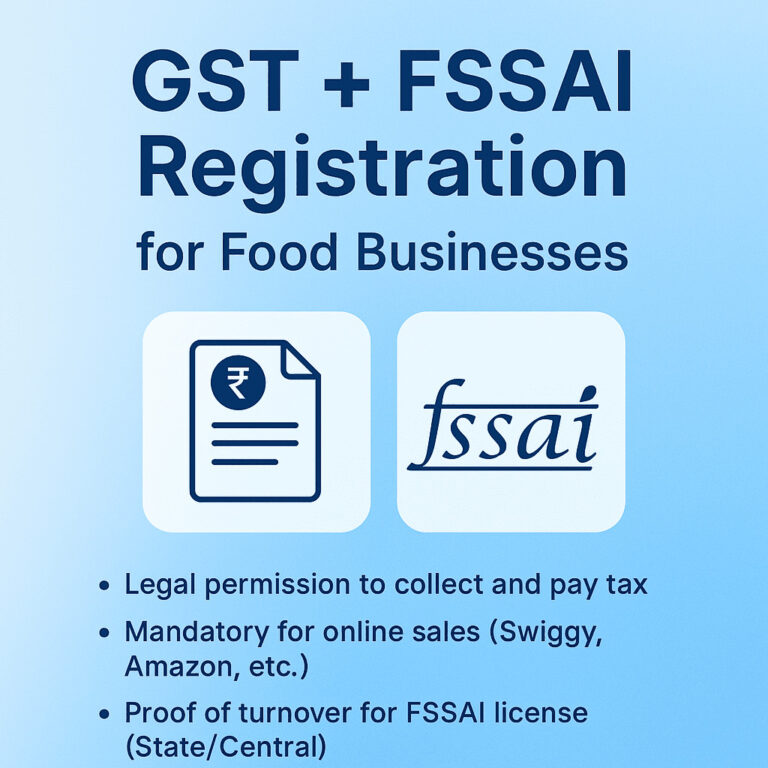
The food business ecosystem requires FSSAI licensing and GST registration for maintaining regulatory standards. The FSSAI license addresses food safety together with hygiene and product standards but businesses need GST registration for Goods and Services Tax compliance purposes. The process of obtaining GST registration serves financial authorities as well as strengthens FSSAI applications by confirming revenue records and operational bases and business locations of food companies that produce and redistribute foods through all sales channels. Accurate brand compliance depends on merging these two official food registrations.
Why GST Registration is Mandatory in India?
GST Registration is not just a legal formality but a crucial compliance requirement for every business in India, especially food businesses. Whether you are running a small food outlet, an online store, or a large distribution network, registering under GST ensures your business remains legitimate, tax-compliant, and eligible for various benefits.
Below are the key reasons why GST registration is mandatory:
- Legal Requirement for Businesses:
Under GST law, every food business must obtain GST registration if its annual turnover exceeds ₹40 lakhs (₹20 lakhs in certain states with special economic conditions). Additionally, GST becomes mandatory if you are:
- Conducting interstate sales, or
- Operating through online platforms like Amazon, Flipkart, Swiggy, or Zomato.
Without GST, your business cannot legally operate in many cases. Moreover, GST registration is also required for applying under schemes such as the FSSAI Tatkal License.
- Strengthens FSSAI License Application:
When you apply for a State FSSAI License or Central FSSAI License, proof of your business turnover, address, and type becomes essential. Having GST registration streamlines this process, minimizes chances of rejection, and strengthens your compliance credibility. - Mandatory for Online Sellers:
If you are selling food products through e-commerce platforms such as Amazon, Flipkart, Swiggy, or Zomato, it is compulsory to hold both:
- A valid GSTIN (Goods and Services Tax Identification Number)
- A valid FSSAI License
Without GST registration, these platforms will not allow you to sell online
- Enables Input Tax Credit (ITC):
One of the biggest advantages of GST registration is the Input Tax Credit (ITC) facility. Businesses registered under GST can:
- Recover taxes spent on raw materials
- Claim ITC on packaging materials, equipment, storage, and delivery expenses
This helps in reducing overall business costs and increases profitability.
- Mandatory for Repackers, Distributors & Exporters:
If your business involves repacking, relabeling, or exporting food products under your own brand, GST registration is mandatory. It allows you to issue tax invoices properly and stay compliant with trade regulations. - Supports Business Expansion Across India:
With GST registration, you can expand your food business seamlessly across India without worrying about multiple state-specific registrations. It enables:
- Hassle-free B2B transactions
- Legal interstate trade under one registration
- A smoother supply chain for nationwide operations
- Builds Compliance and Trust:
Dual compliance with GST registration and FSSAI registration builds strong credibility for your business. Buyers, vendors, auditors, and partners trust businesses that follow both food safety and tax laws, helping you attract more opportunities.
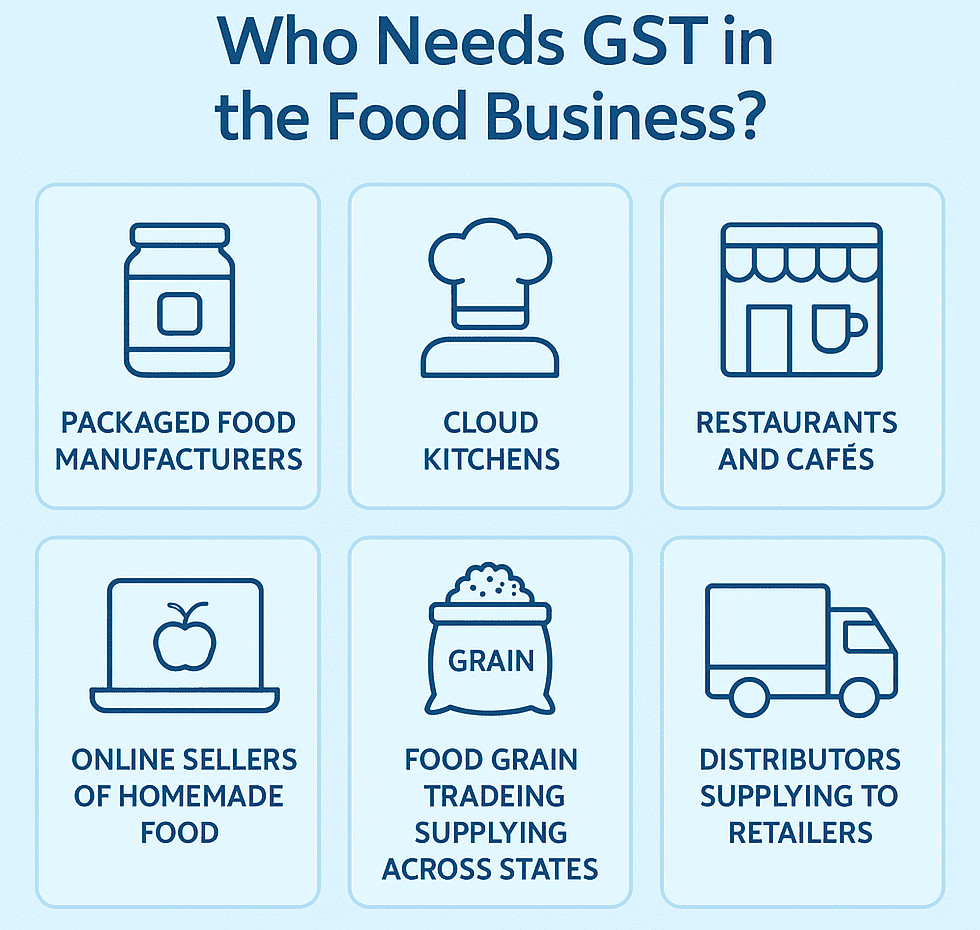
- Food Manufacturers & Processors:
All food manufacturers and processors with an annual turnover exceeding ₹40 lakhs (₹20 lakhs for North-Eastern and hill states) must obtain GST registration.This registration is compulsory regardless of whether your business distributes products within a single state or across India.By completing GST registration, your business gains:The ability to issue valid tax invoices, and access to Input Tax Credit (ITC) benefits on raw materials, packaging, machinery, and other business expenses.
- Food Repackers / Re-labellers:
If your business involves repacking, relabeling, or rebranding food items like ghee, grains, or snacks under your own label, GST registration is mandatory.It allows your company to issue compliant tax invoices, sell products through retailers, distributors, or online platforms, and build credibility with suppliers and buyers.
- Online Food Sellers:
Running an online food business requires GST registration, even if your turnover is below ₹40 lakhs.All e-commerce platforms such as Amazon, Flipkart, Swiggy, Zomato, and other marketplaces mandate a valid GSTIN (Goods and Services Tax Identification Number) for product listings.This means that any seller offering food through digital platforms or their own website must obtain GST registration to operate legally and receive payments smoothly.
- Multi-State Operators / Food Chains:
If your food business operates across multiple states, you must register for GST separately in each state where your business has a physical outlet, warehouse, or distribution center.Multi-state GST registration ensures smooth interstate trade, proper tax compliance, and eligibility for Input Tax Credit across all operational regions.
- Exporters of Food Products:
Businesses that export packaged or processed food products are required to obtain GST registration along with a Letter of Undertaking (LUT) to enable tax-free exports.Registered exporters can claim GST refunds and input tax credit benefits.It is also essential to hold a Central FSSAI License to accompany your GST process for export approval.
- Wholesalers and Distributors:
All food wholesalers, distributors, and bulk traders supplying to retailers or other businesses must have GST registration.It enables:Issuance of valid B2B tax invoices,smooth tracking of goods and tax compliance, and access to Input Tax Credit, which lowers overall tax liability.With GST registration, wholesalers and distributors can also build long-term trust with their clients and expand operations across states.
- Retailers (Turnover Above ₹40 Lakhs):
Any retailer, supermarket, or grocery store with an annual turnover above ₹40 lakhs (₹20 lakhs for North-Eastern and hill states) must obtain GST registration.Benefits include:Legal capability to issue tax invoices,Eligibility for Input Tax Credit, and the opportunity to expand into B2B sales or multiple branches across India.
FAQs
1. Does FBOs holding FSSAI licenses need to register for GST or not depends on their annual turnover threshold?
The terms and conditions of GST registration require all food businesses to obtain it when they generate annual revenue above ₹40 lakhs (for goods) or ₹20 lakhs (for services) or ₹10 lakhs (in special category states). Every online vendor (e-commerce) must get GST registration irrespective of their revenue levels.
2. Is it possible to obtain an FSSAI license without having GST registration?
An FSSAI license application can proceed even when the business owner has not registered for GST. The requirement for GST registration arises once your business turns to either exceed the GST threshold or starts to conduct inter-state or online sales.
3. I have GST but not FSSAI. Can I run a food business?
No. All India food business operations require a legal FSSAI license/registration to start. The taxation system operated by GST regulates tax matters while FSSAI administers food safety policies.
4. Is the combination of FSSAI and GST registration provides dual advantages for business operation?
- Legal recognition and trust
- E-commerce markets accept applications to sell from businesses that meet their specific requirements
- Food establishments gain easier opportunities for obtaining loans and funding through established channels
- Seamless supply chain operation with proper invoicing
5.DoesFSSAI application details should have identical GST number information?
Yes. The correct synchronization between your FSSAI and GST business details (name and PAN address) prevents issues that occur during inspection and licensing procedures and financial bank checks.
6. Am I required to obtain FSSAI or GST registration if I prepare food at home for limited sales? Do I need GST or FSSAI?
The requirement for FSSAI basic registration depends on having an annual turnover under ₹12 lakhs.
The FSSAI registration necessitates obtaining GST number unless you manage below ₹12 lakhs turnover or operate through e-commerce channels.
7. It is possible to submit applications for both GST and FSSAI in a combined fashion?
The system lacks a unified application platform but you can initiate separate applications for performing both registrations. Compliance service providers present combined packages that streamline the procedure for their clients.
8.Does the GST system impose tax on unspecified food items?
Consumers do not need to pay GST taxes for unbranded loose food items such as grains together with fruits and vegetables. The implementation of GST depends on produk type and HSN code assignment after packaging and branding.
9. I am a food grain trader. Do I need FSSAI and GST both?
A Food Safety and Standards Authority of India license is mandatory for dealing with food products.You need to register for GST if you meet the threshold amount of turnover or do business between interstate states or through online means.
10. Will my GST status might influence the process of renewing my FSSAI license?
Indirectly yes. Participation in regular inspections and renewal checks requires authorities to compare your business operations with GST filing records to verify authenticity.
11. Is GST mandatory for food businesses selling on platforms like Zomato, Swiggy, or Amazon?
Yes. Any business selling food through e-commerce platforms must register for GST irrespective of turnover, even if annual sales are below the basic threshold limit.
12. Does having an FSSAI license automatically require maintaining GST records?
Not necessarily. FSSAI governs food safety, while GST governs taxation. However, once a business is registered under GST, it must maintain proper invoice records, file returns, and keep documents aligned with FSSAI data for inspections.
13. If I operate a cloud kitchen, do I need both GST and FSSAI?
Yes. Cloud kitchens are treated as commercial food businesses.
- FSSAI license is mandatory for preparing food.
- GST registration is required if turnover crosses the threshold or if the kitchen operates via online platforms.
14. Is GST required for homemade food businesses delivering only within the same city?
No, until your turnover crosses the GST limit.However, if you sell through online marketplaces, GST becomes mandatory regardless of city or turnover.
15. Does GST apply to packaged food with no branding?
Unbranded or loose food items are generally exempt from GST.But once the food is packaged and branded, GST applies according to the HSN code.
16. Does my GST certificate address need to match my FSSAI address?
Ideally yes. Mismatch in business addresses can lead to queries during inspection, renewal, or bank verification.If addresses differ due to operational reasons, the business must provide supporting documents.
17. Can a small food vendor with turnover under ₹12 lakhs operate with only FSSAI registration?
Yes. A vendor may operate legally with Basic FSSAI Registration if turnover is under ₹12 lakhs.GST becomes mandatory only upon crossing threshold, selling online, or interstate business.
18. Do restaurants need GST even if they only offer dine-in services?
Restaurants must register for GST when annual revenue crosses ₹20 lakhs (or ₹10 lakhs in special states).Below this limit, GST is optional unless they sell through online delivery platforms.
19. Do exporters of food products require GST and FSSAI both?
Yes.FSSAI License is compulsory for handling/exporting food items.GST registration is needed because export transactions require GSTIN for LUT (Letter of Undertaking) and documentation.
20. What happens if my GST registration gets cancelled—can I still renew my FSSAI license?
Yes, you can still renew FSSAI as long as business operations are legitimate.However, authorities may request clarification or proof of continued operations where GST linkage is relevant.